
Every entrepreneur I know falls somewhere on the spectrum between paranoid to full-blown “the world is conspiring against me” paranoid. This is no surprise because only the paranoid survive. It creeps up everywhere: will a competitor lap me? Will a key employee leave? Will I lose that partnership? I just pitched an investor, are they going to share information with people I don’t want them to? A strategic is trying to acquire us, are they just fishing for information so they can directly compete? The list is infinite. No matter how well things are going, there is always something suspect in the air.
One area where paranoia always crept in for me was when investors asked whether I thought another company was competitive. When building GroupMe and Fundera my answer always defaulted to “Yes, of course.” At GroupMe if someone wanted to invest in a group-buying company, we’d block it because we had “Group” in our name and one day we might converge. If someone wanted to invest in a SMB insurance marketplace, we’d be insulted because we wanted to be the Everything Store for SMB financial products at some point in the next 5-100 years. My feeling was that investors made their bet on us, and anything even remotely adjacent or tangentially related was a blatant affront and off-limits. If they asked, I’d block it.
Now that I’m on the other side of the table, I think about this a lot.
When starting Fundera, I actively sought to work with investors who knew about our space. We were building a marketplace/brokerage for SMB loans, and we were relatively new to this world. If an investor had previous exposure to SMB lending it was a plus. Two of our first investors, First Round and Khosla Ventures, had invested in OnDeck Capital, a direct lender that would become an important partner and customer of ours. This was a positive signal to me - they believed in the space. Another one of our investors, QED, had invested in another SMB lender that became an early partner and customer of ours. In no way did I view this as a conflict, it was a positive differentiator.
But once we had an investor’s money, something changed for me. Whenever they’d try to make a new investment in a direct lending company (similar to the aforementioned ones), I’d attempt to block it, claiming it was competitive. This was irrational behavior. If it didn’t matter before, why would it matter now? I remember when one investor told me he made an investment in a direct lender without asking for my permission beforehand, I was absolutely livid. All I could see was red when he explained their new investment. (The company ended up becoming another important paying customer of ours, and the founder became a friend of mine whose next company I invested in.)
Reflecting on this, it seems hypocritical to feel this way and I’ve tried to piece together why that was the case. When the investment in Fundera (which actually felt like an investment in “me”) followed an investment in a direct lender, I felt validated, as if the investor made a previous mistake and was course-correcting by supporting us. But when the opposite happened, I felt betrayed, like the investor believed they made a mistake and we weren’t good enough. My feelings were real, but my assumptions were wrong. This was not an indictment of me as a person or a loss of belief in the potential of the company itself. It was an action reflective of a growing conviction in the space and a desire to deepen its financial investment in a theme they believed to be important. This was not supporting a competitor, it was strengthening a complement.
I think this will always be a sensitive topic and a tricky area to navigate. Some investors can be very helpful if they have exposure to a space and know the relevant players and industry dynamics. It’s easy to try to present making investments in an adjacent company as a logical and potentially beneficial thing to an entrepreneur, but investors should be empathetic and recognize that entrepreneurs have real feelings and are inherently paranoid about this. I don’t think investors should ask for permission, but they should always ask a Founder's opinion and factor it into their decision-making. At the end of the day, they’re only left with their reputation. For entrepreneurs, it’s important to internalize that these investment decisions are not a critique of them as a person or their business (unless the VC deliberately invests in a direct competitor, then they are asking to be written off). In fact, these actions can be a way of doubling down on your future. It’s hard to separate feelings and perception from intent. These situational dynamics are important and can get messy very quickly. There’s no substitute for putting yourself in the other person’s shoes.
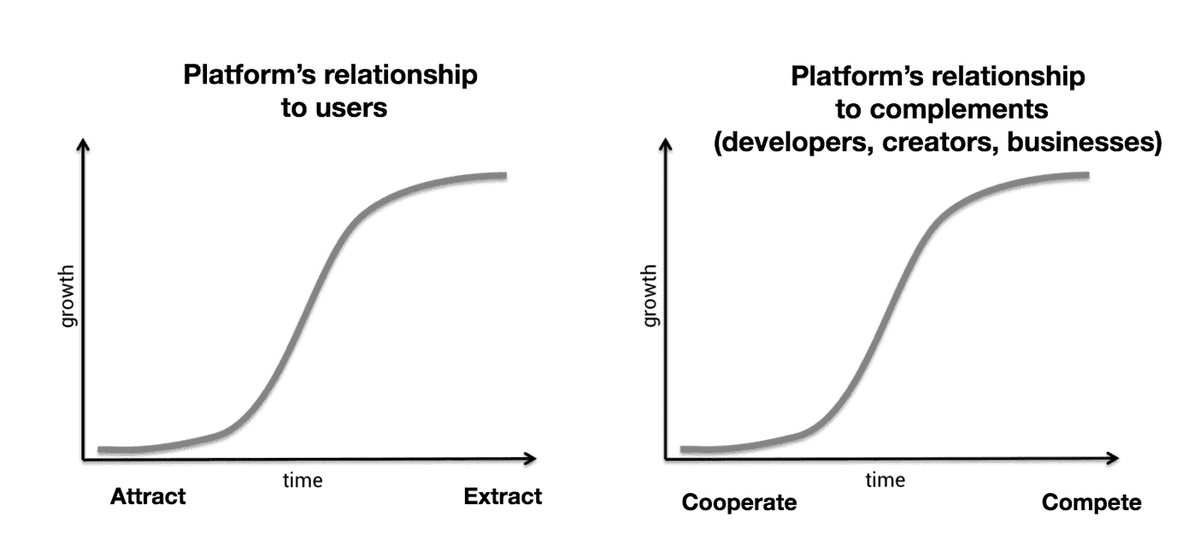
One of the things that I’ve always found compelling about web3 is the concept of user-owned networks. In web2, many networks were built on the backs of their users and developers. As the famous Chris Dixon example goes, networks and platforms do what they can to attract and cooperate with ecosystem participants early on. Then, as they hit the tops of their growth S curves, they pivot to value extraction and compete with the complementary applications that got them there in the first place. Web3 companies work to avoid this dynamic by giving the participants who help build and grow the network ownership in it. This is a powerful concept and an important ideal. It helps bootstrap networks and creates trust, guarantees, and aligns incentives.

One of the things I am interested in is web2 companies applying this web3 superpower to their domain. I am beginning to notice more of it in the wild. There are different flavors of this ranging from profit sharing to owning actual equity in a company. Bookshop.org gives 80% of its profit margin to independent bookstore in its network. It doesn’t have to do this, but it strengthens its network and creates preference in both buyers and sellers on the platform. When I buy books online I make sure to do it on Bookshop. YouTube has done an exceptional job nurturing its community of creators by famously awarding them 55% of the network's ad revenue.
With regards to equity, Nebula TV has taken a bold approach awarding the creators who produce content for the platform with 50% ownership. And while it may have been more of a marketing stunt than a thoughtful distribution of ownership, NuBank awarded $11.2m in stock to its depositors when it went public. I am sure there are plenty more instances of this happening, and I want to learn more about them.
I find these examples exciting because they are representative of a movement that distributes ownership of internet properties across a broader set of constituents. I hope that this type of practice becomes commonplace because the people who supply the products that power networks - whether books, content, money, or otherwise - should have incentive to stick around and participate in the upside. I don’t think all companies need to give away majority chunks of ownership to their network participants, but token gestures go a long way in establishing trust and preference.
I would like to see more of this, particularly companies that are able to harness this superpower and deliver it to users in a way that abstracts away the complexity of crypto rails. The concept is one of the most powerful things that can drive incentive alignment and value creation on the internet, and I think it can help web3 cross the mainstream chasm.
AI is fundamentally changing the way we interact with technology. It has started with language and voice as an interface, and it will continue with the rise of agents. I think of agents as pieces of software that can do your bidding on the internet. They can navigate web, mobile, and desktop applications to accomplish tasks on your behalf. The recent Rabbit launch demonstrated to us what this can look like.
Agents are an inevitability. If mobile applications are remote controls for real life, agents are the universal remote. This begs the question of whether web2 companies that have built business models on top of pre-AI interaction models will adapt or even participate in the agent world. If services like Uber, Kayak, and Instacart generate a meaningful amount of revenue through advertisements and cross-selling products, will they want their application interfaces to be abstracted away by an agent? Are they okay with their customers never interacting directly with their applications and losing their eyeballs? Their incentive structure is at odds with agent proliferation. This is a potential innovator’s dilemma in the making.
New conversational interfaces made possible by AI will create a new category of “agent native” applications. Since agents will interact with them instead of end-users, these applications will be headless by nature. They may be entirely unknown to users and simply run in the background, happily playing their part in a series of chain reactions. These will be protocols that our agents call on in the world of bits and they will also bridge to atoms (eg ride-sharing, grocery delivery, etc.).
This is likely a scenario where AI and crypto will be two sides of the same coin. AI will create the need for agent-native headless applications, and web3 will step in to fill the void. Web3 applications and protocols can accommodate the new ways in which we will use technology (i.e. conversational and voice-centric interfaces with agents working for us) because they do not need to “own” end-to-end customer experiences unlike most web2 companies. They are happy to run in the background as composable job-doers. They don't need their brand names front and center because their tokenized business models, which are primarily straightforward and network usage-based, are positioned to thrive in this world, especially relative to their web2 counterparts.
I suspect we will see more and more of these “two sides of the same coin” scenarios emerge as AI and crypto continue to weave their way into our daily lives.

