
Social media platforms have evolved in a variety of different ways. Some are about sharing things with friends, and many of them have become a way for creators to put content into the world to entertain an audience. It very much feels like the dominant platforms today have become sterile. We use them, but they’re not fulfilling, nor do they have the pioneering sense of adventure and wonder they did as they emerged many years ago.
Recently I wrote about how something magical is happening onchain in consumer social. The Warpcast community feels like the early days of Twitter, and the openness of Farcaster has made the feed an experimental playground similar to early Facebook when third-party apps like Zynga could build companies on top of the FB social graph.
There’s an emergent playbook for building consumer social apps in web3. It begins with a skeuomorphic version of the web2 counterpart that the crypto community embraces. People onchain have a real willingness to experiment with new things, so acquiring early users is much easier in web3 right now than it is or was in web2. During this first phase, it’s important for application developers to hone in on what makes their product uniquely differentiated from their offchain comp. What are some of the defining characteristics that are only possible onchain, and how will that create preference amongst users so it can cross the chasm to a non-crypto audience? Here are some early and obvious ideas:
Applications that enable creators to monetize have the ability to offer meaningfully lower costs. This is the “your margin is my opportunity” play. Why pay Patreon a high rake when you can use Hypersub? Why Substack when you can use Paragraph which is 50% cheaper? Less extractive fees will create economic preference amongst creators, and these savings can be reinvested in their art and livelihood.
Financialization is a major feature of crypto. With onchain social media, creators can do things like allow their audience to benefit and participate in a creator’s growth and upside economically. That’s something that has never existed before and a real incentive for fans to help creators expand their audience and flourish.
We talk a lot about the ability to own your audience and bring it with you wherever you go. This is one of the pillar features of web3. Farcaster cannot shut down your account the way Elon Musk can. Your audience belongs to you which means that you can distribute an infinite variety of content to them through a multitude of different applications and interfaces.
Open data and composability enable a lot of experimental things to happen in crypto. Usually when someone shares media to a platform, it stays within the confines of that platform. It’s hard for it to proliferate across the internet and make its way into a variety of different applications. The only place this really happens in web2 is when a publisher embeds a tweet, instagram, or video. In web3, an atomic piece of media or data can be reshared across any onchain platform, and a creator can and will consistently be compensated for its distribution regardless of where it was originally posted. Because media is tied to your identity instead of a specific platform, it can live in many different places simultaneously, wherever you choose to go. That is immensely powerful.
There are still plenty of hurdles to deliver a UX that will draw in an offchain user base. Current onchain social applications are too insidery. Connecting crypto wallets is not something the average internet user understands. Paying with tokens is not a widespread behavior. These things will need to ultimately be abstracted away from UX in order to onboard billions of people. Fortunately, many tools that help solve these issues are being developed and adopted.
Ultimately, users go where their friends and content creators are, and creators go to pockets of the internet where they can get distribution. Right now, given the lack of a scaled onchain social network, robust distribution is a missing link for offchain creators looking to make the migration. Perhaps the rapid experimentation and composable nature of onchain consumer applications will help to solve this problem. We may very well find that sooner rather than later web3 offers a much richer distribution opportunity across a variety of different networks and platforms, and there’s an argument that it’s easier to be early to a network and build an audience as opposed to arriving late to the party. It seems that the right approach is not to try to convince web2’s biggest creators to drink the kool-aid, but to make sure that the onchain gravity is so strong that tomorrow’s biggest creators emerge on web3.

For a long time, the web3 ecosystem had to organize and communicate on web2 platforms. From the memes of crypto twitter to the project-specific communities that congregated in Discord and Telegram, there were no dominant web3 platforms. That is changing quickly and there is something special happening in web3 social right now.
Over the past several years, we have seen a series of new projects emerge that finally give the web3 community a place of their own. They are unique, constantly evolving, and growing quickly. These projects have real tailwinds because people who like crypto have an explicit preference to use crypto-native products instead of web2 ones (even if they are less convenient to use), they are willing to experiment with and try new things, and nascent communities are always more fun than big ones with a lot of noise.
The trend for a lot of these projects is that they begin as a skeuomorphic representation of their web2 counterparts to attract an initial audience, and then they rapidly experiment to introduce weird and crypto-native features. This is just the beginning of what we are seeing:
Twitter ➡️ Warpcast
Reddit ➡️ Warpcast Channels
Tumblr/Instagram ➡️ Zora
Substack/WP ➡️ Paragraph
Discord ➡️ Towns
Patreon ➡️ Fabric
TikTok ➡️ Drakula
I’m sure there are plenty of other examples I am missing here. In all of these instances, the web3 version initially mirrors the web2 counterpart, but then they quickly diverge. A lot of times this divergence is marked by some crypto-native feature: financialization and minting as a web3 version of “liking,” things that can only happen because of web3 composability like Frames, the emergence of memetic tokens that transcend applications like DEGEN, etc. All of these things are new, they are weird, and they are uniquely web3. The other characteristic they share is they are simply more fun and entertaining than anything that exists in web2.
Jared Hecht on Warpcast
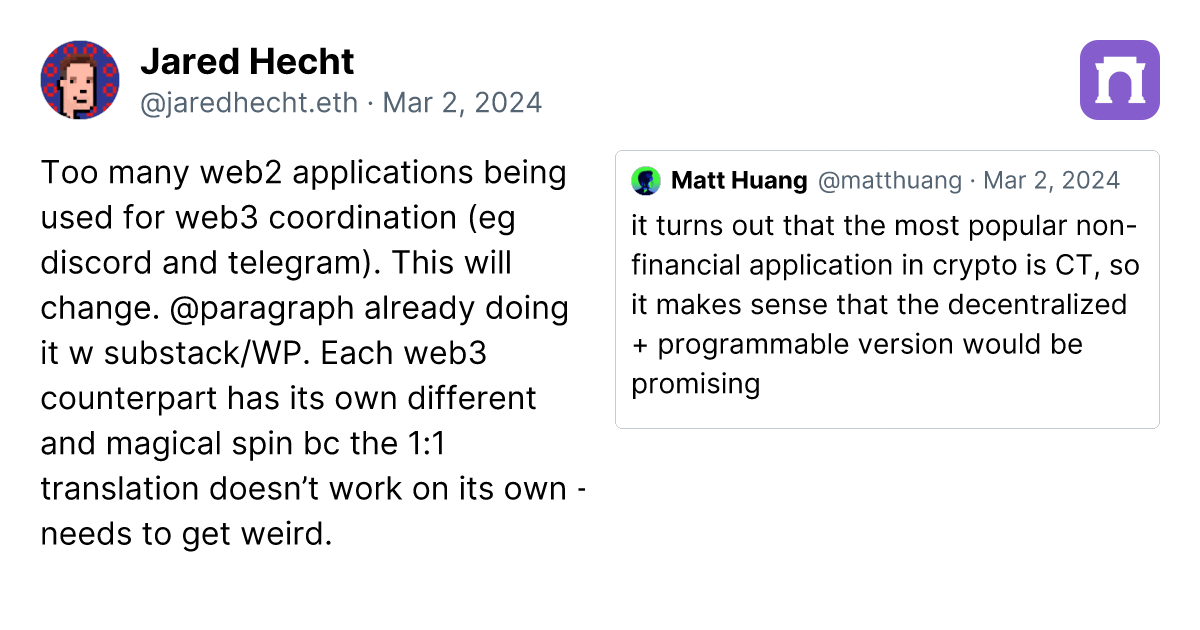
Too many web2 applications being used for web3 coordination (eg discord and telegram). This will change. @paragraph already doing it w substack/WP. Each web3 counterpart has its own different and magical spin bc the 1:1 translation doesn’t work on its own - needs to get weird. https://warpcast.com/matthuang/0x693c9e2c
We are now beyond the hand-wavey language and posturing and pounding the table on “everything needs to be open and portable and LOUD NOISES” We are seeing applications emerge that are fun, have real DAU and utility, are birthing products and memes that transcend beyond those communities, and represent the beginning of a new wave of emergent social networks that are fundamentally different. And while it’s still early (when will it not be“early?”), things feel more promising, useful, and engaging than they ever have.
At the very least, it’s a joy to see so many people rapidly experimenting together, building new products and features that could have never existed before, trying new things, and having a good time. It’s very reminiscent of early Twitter where an early community of curious people took a platform and morphed it to their liking. Now it gets to happen all over again, just with a new set of tools, functionality, and a permissionless and open system to ensure its future belongs to everyone.
One of the most important skills founders must hone is their ability to tell a compelling story. Part of that story, if they plan or want to use venture capital as a tool to grow, is articulating how much money they want to raise and what they plan to do with that money.
When raising capital, it amazes me how many founders will say something along the lines of, “Well, right now the market for Series A companies is $X, so that’s what we want to raise.” I find that type of finger-in-the-wind talk extremely lame and weak. It means that you haven’t taken the time to truly think about what your goals are - e.g., growth objectives, what you need to learn, build, and prove, and what resources you need to accomplish those things - and the capital requirements to get them done.
One of the things my investors taught me is that entrepreneurs need to be good stewards of capital, and part of that is having a very keen sense of what to do with it. When raising money at groupme and fundera, we always had a crystal clear idea of how much money we wanted to raise and why. Sometimes it was to be able to pay for some rapidly accelerating variable costs attributed to our fast growth; other times, we needed to invest in hiring people with different types of skills to build things like new mobile clients, or we wanted to scale a sales team after we had a basic sense of our payback periods and how we’d operationalize onboarding and ramp cycles. This wasn’t rocket science or even calculus, it was just a simple model we’d build in a spreadsheet. It demonstrated that we had some modicum of an idea as to what we’d spend money on, when we’d spend it, and why. And it’d be reflected in a basic pro forma and financial model that would grow in sophistication as we learned more about our business over time.
Some frameworks for this can be a simple comparison of what your company looks like today versus what it will look like in a future state due to this fundraise across a series of different attributes: team size and composition, customer or user growth, revenue growth, product features, releases and milestones or markets you’re live in, etc. Demonstrate and convey what will be different about your business when you raise the money. “We want to raise $10m to accomplish these things and have some buffer to invest in new initiatives opportunistically” is an infinitely better answer than “$10m feels right for us.” One shows you might be a thoughtful steward of capital, and the other is a total turn-off.
The process of doing this work isn’t super time consuming, and it’s remarkably important to help you think through just what it is you want to accomplish with money. If you’re asking for capital, at least have the wherewithal to answer these basic questions for yourself let alone investors. You’re selling a piece of your company. Be thoughtful about why you want to do that and why it will be worth it.

